ipohWorld on Facebook

Chatterbox


Events

September 2010
M T W T F S S
« Aug    
 12345
6789101112
13141516171819
20212223242526
27282930  

Would you like to be an original author of this blog?

We are looking for a limited number of authors who would like to contribute articles on this site, about heritage topics in Perak. If you would like to be one of our authors, please email us at info@ipohworld.org and we can register you as an author. However, should we find unsuitable content being proposed, the author and content will be deleted without notice. We look forward to hearing from you.

The weaver girl from Shun Tuck.她来自顺德.

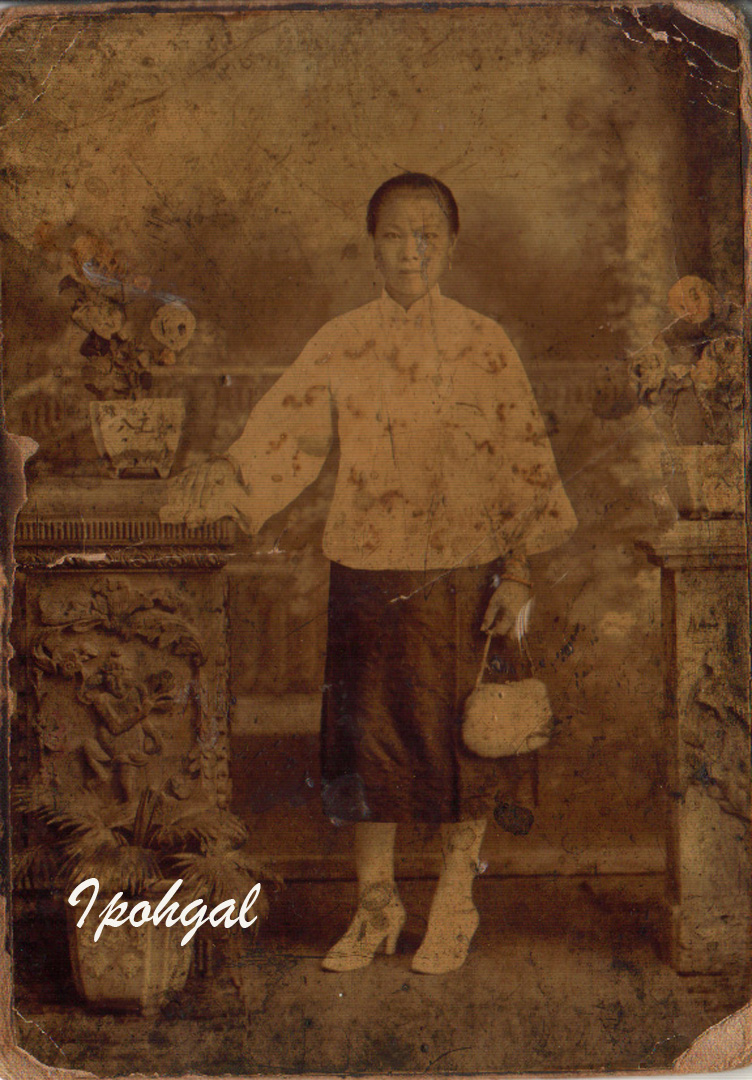
Chan Tai 陈黛, the charming girl in this photo, used to live in a small village in the district of Shun Tuck 顺德 in the province of Guangdong, China in the 1920s. This district was renowned for producing silk. Her family owned a small silk worm farm. She helped them to cultivate silk worms and weave the silk thread into cloth.

One day, a professional matchmaker called “mui yan poh 红线人” approached the family with a marriage proposal. A guy in Ipoh, Perak, Malaya, needed a wife and was looking for a girl from a decent family.

In those days, many families in small villages in China dreamed of having their daughters marrying off to faraway lands and lead a better life. At that time, Perak was famous for tin and it was very fashionable to come to this land of plenty.

The prospective groom was a guy called Chow Yee Phooi 周毅錇, from the district of Phun Yee番禺. He has already migrated to Malaya together with his brothers many years before. He was the youngest among the brothers and the only one still single and eligible.

They opened a shop selling fruits in Ipoh. This shop, called Chow Hang Kee 周亨记 , distributed fruits to other fruit sellers in the market nearby. The shop was located between Yik Foong Complex and Lam Looking Bazaar, facing the back portion of the present Pasar Besar Ipoh.

Life was good to him. Flamboyant and carefree, he always frequented gambling dens in his spare time. He was particularly fond of mahjong and “pai kao”, a game of black tiles.

In the past, a girl has no say in her marriage. Everything was decided by her parents.  The Chinese called it “Mang Fun Nga Kar 盲婚哑嫁” meaning a “blind and mute marriage”. She has neither meet the groom nor can she voice out her opinion about the match. As a daughter, she just has to follow everything planned for her.

Her parents gave their approval at once and a simple wedding ceremony was conducted in her village, minus the groom. In his place, a cockerel was used in the ceremony although I don’t know why they chose this animal to represent the groom!

After the wedding ceremony, she left her village and boarded a steamer, stopping at Singapore first and then later, Malaya. Next, it was to Ipoh.

Upon her arrival, this photo was taken. The purpose of taking this photo was to send it back to her family in China to show them that she has arrived safely to her new home. There were only two such photos. One she sent back to her family and the other appeared in this blog, which she kept as a keepsake. Later, it was handed down to my mom who was her eldest child. Mom gave this photo to me. Today, this is the most prized item in my collection because it is the oldest and the only photo of my maternal grandmother.

From this photo taken circa 1920s, you can see that she was a very stylish lady, an epitome of an Oriental beauty of her time. She sewn the white samfoo and black knee length skirt herself, using the silk cloth which she had weaved. It was part of her wedding wardrobe, looking prim and proper to face her new husband and his family. Her hair was combed neatly into a bun. She was also wearing a pair of white leather high heeled shoes and carrying a white fur handbag. Such a graceful blend of East and West.

The family stayed in Kampung Kuchai, Ipoh. Needle work was her main forte. She sew baby’s clothes and accessories like gloves, booties, caps and carriers for some extra pocket money although her husband’s income was sufficient to support her. She was a very quiet and gentle person, yet fiercely independent, earning her own keeps.

But alas, her life was tragic! In 1930, she gave birth to my mom. Soon, another daughter followed and the next was also another girl! Three girls in a row and soon her mother –in law began to show her displeasure. No son was produced and that was a bane for the family. Under mental pressure, she conceived again although her health has deteriorated. But by now neither her husband nor her mother-in law show any concern. In their mind, it will be yet another girl. Girls were so unwelcomed in a Chinese family at that time. They preferred boys to carry on their surname and attend to the family altar. This was a typical Chinese mindset at that time. Luckily, it was not like this anymore.

Her parents came from China to Ipoh to visit their daughter. After a brief stay, they went back to China, bringing my mom together with them to lessen their daughter’s burden of looking after the children in her fragile condition. It was 1938 and my mom was only 8years old then. She spent the next four years in Shun Tuck together with her grandparents, helping them to feed the silk worms with mulberry leaves.

Not long after her parents left Ipoh to go back to China, one day, my maternal grandmother experienced a terrible stomach pain at home. She was already in her seventh month of pregnancy. She sent her two young daughters out to search for their father and asked him to come home at once. That day, he was not at the shop. Instead, he was at the mahjong parlor near home. He was an addicted mahjong player and was too engrossed in his game to bother about his pregnant wife at home.

“Go home and don’t bother me! Ask her to apply some medicated oil and get a rest!” he barked at his young daughters as they pestered him to go home quickly to attend to their mother.  The mother –in law was nowhere to be found. The two young girls were at a lost as to what to do seeing their pregnant mother in pain. Finally they called their neighbor for help.

It was late at night when my maternal grandfather finally came home. His face was as dark as “Kuan Kung 关公”from losing money at the mahjong parlor. A midwife had just left the house. On the bed were a stillborn baby boy and his dead wife, paled and cold from losing too much blood. His two young daughters were sobbing at a corner, traumatized at seeing their dead mother and baby brother. My maternal grandmother was about 28 then. What a young age to die and in such a tragic way. 

To a Chinaman at that time, losing a wife is akin to losing a shirt. I really don’t know how he must have felt at that time but according to my aunts, he looked very cool and calm. After burying his dead wife and stillborn baby, he approached a matchmaker to look for another wife and in a few months time, a new one was found and life was back to normal again, at least for him.  My poor mom and her little sisters found themselves with a stepmom but luckily she was not exactly the type from hell. But nevertheless, life was not the same anymore without your own mother.

According to my mom, one night, while she was sleeping in a dimly lit room in her grandparents home in Shun Tuck, she was awoke by an apparition of a lady beside her bed. She opened her eyes and saw that it was her mom. The apparition was sobbing softly and was trying to pull a blanket to cover her young daughter. It was gone in a blink of an eye. At that time, my mom has not learnt about her mom’s death yet because she was far away in China. A month later, a letter from her father in Ipoh reached her, informing her of her mom’s death.

Many years later, my maternal grandfather was blinded by firecrackers being carelessly thrown out from the window of a shop near Foh San Restaurant at Osborne Street. He was just coming out from a mahjong parlor at that time. That incident stopped him from playing mahjong ever again.

In 1980, on his death bed, while breathing his very last, in a very weak voice, he asked his daughters for their forgiveness for neglecting his first wife and depriving them of their mother’s love. His last words were, “I deeply regretted my folly. I still loved her very much. She was a good wife. She is beside me now, waiting for me. Please forgive me and goodbye. I am going to be with her again.”

My mom and her sisters have finally forgiven their father and came to terms with their profound loss.

Related Posts with Thumbnails

40 comments to The weaver girl from Shun Tuck.她来自顺德.

  1. KLboy
    July 24th, 2010 at 2:26 pm

    Hi Ipohgal, sometimes the Chinese traditions are quite confusing but interesting.
    Ok, you see, in Confucian way, the Chinese weddings, when one who is seriously ill or not available(mean sudden death) to attend the ceremony, then a chicken can be used as a substitute for. A close relative of the absent bride/groom holds the chicken so the ceremony may proceed and a red silk scarf is placed on the chicken’s head. This is what we called a ghost marriage (also known as a Minghun or spirit marriage) is a marriage in which one or both parties are deceased. However, this practice is rarely on today.
    But for your maternal grandpa’s marriage was totally different, they used cockerel but not rooster, cockerel is a immature male chicken of less than a year’s in age,also mean “virgin guy”. Haaaaaa…… I not so sure whether it was true or false , but this was told by some elderly. Actually,this method will save all the trouble and extra expense to get married, since both had a distance away. Not like today’s
    world, you can fly from UK or US in just roughly about 16 to 18 hours.
    Haaaa…… humans are always having commonsense and also considered clever in calculation.heee..
    Anyway have nice weekend to all.

  2. ipohgal
    July 24th, 2010 at 2:54 pm

    Well, whether my maternal grandpa is a virgin guy or not, nobody knows,hahaha.

    But what I knew after hearing this story from my mom is that my maternal grandma was really in for a raw deal!

    I really pitied her. She could not get to meet the prospective groom and find out more about his characters. Worst, she cannot say no after her parents had said yes.

    But the biggest woe was her mother-in law. The pressure to bear sons just to perpetuate the family surname and attend to the family altar is so unfair. It is as if the fault lies entirely with the woman and not the man. They are not aware of the xx and xy theory, of course.

    In those days, many mother-in laws encouraged their sons to take concubines to spite their daughter-in laws for the failure to produce sons.This is true for some well to do families. Sometimes women are their own worst enemies.

    Luckily we lived in different times now. A female child is much cherished and loved by the parents. And we ejoyed the same attentions and benefits as the male child. So, the birth of daughters is an equally joyous occasion and they are welcomed with open arms.

  3. KLboy
    July 24th, 2010 at 5:09 pm

    Although,time can’t mend or repair anything in the past,but everthing has changed now.
    Pity your maternal grandma ,a sad life story indeed.

  4. Song
    July 24th, 2010 at 5:38 pm

    Well done author from Ipohworld ! I truly enjoyed your blog. Thanks

  5. riversidegrass
    July 24th, 2010 at 6:57 pm

    Hi there,“Mang Fun Nga Kar 盲婚哑嫁 ~ Blind and mute marriage “include of “sam pol cai新妇仔 or童养媳”, it was one of them. Let’s talk about this, the “sam pol cai新妇仔 or童养媳”, normally the said family had to send or sell his/her little girl (bride to be) to the boy (the groom to be)’s family. The groom to be family will taking care of all the growing up expenses, a marriage ceremony will be conducted only when the pair reaching appropriated age for marriage, as early as 16 years or so and some even earlier. One reason why boys are welcome in most Chinese family in older days, boys can carry on with their surname , can become part of the family man-power and also attend to the family altar. Another reason was certain poor family unable to raise so many children, so the girl will have to be sacrificed in the sake of the rest. Gosh! How treat unkindly or harshly to female in those days. This was a typical Chinese mindset at that time. Haaa…. Luckier the girls are today, they can have their own choice, although there are still a number of inequalities still exist.Any say from you ?

  6. Leong Yew Kee
    July 24th, 2010 at 6:57 pm

    Hey Ipohgal,
    This is really great. My parents came from Pun Yue and Shun Tuck (now known as Shunde). We have something in common. But the story is different. I may visit Shude again in October/December. Like to visit your relatives there?

  7. ipohgal
    July 24th, 2010 at 8:29 pm

    Hi Mr Leong, I am glad to learn that your parents also came from the same districts like my maternal grandpa and grandma.I think these two places are next to each other. Gotta look at the map again.

    I really have no idea where these places were except they are in the province of Guangdong. My relatives from my mom’s side were here so long that they have lost touch with their relatives back there. Same with the relatives from my dad’s side in Nam Hoi, also in Guangdong.

    So, no, never thought of visiting these places because not familiar with anyone there. All ties were severed many many decades ago.

    However, I am curious as to what happen to the shop called Chow Hang Kee in Ipoh whose location I have mentioned above. The last I knew it was still there but was taken over by the grandchildren of my grandpa’s brothers. I would like to drop by and have a peep. After all, I knew one of their sons. He was my former colleague and a suitor until we found out we were actually relatives and he was very devastated!

    Aah, how small this world is!

  8. Gordy
    July 25th, 2010 at 5:18 am

    What a moving and tragic story. They say your whole life is replayed in slow motion in your dying moments and I wonder if that was what happened to your maternal grandfather(no offence). Thank god such chauvinistic attitudes are not acceptable in any societies these days. However, now and then when I read about some horror stories on mail order brides (I guess this must be the modern day equivalent) I wonder how much has changed? As in many things in life I’d like to think that there were also happy endings for some of these type of marriages. Let’s hope so.

  9. felicia
    July 26th, 2010 at 8:55 am

    “…The shop was located between Yik Foong Complex and Lam Looking Bazaar, facing the back portion of the present Pasar Besar Ipoh…”
    Ipohgal, as far as i remember that area is now a row of shops. don’t know if this particular shop you mentioned is still there…maybe next time i’ll keep a look out (wonder if the old name is still there…or maybe they’ve changed it?)

  10. ipohgal
    July 26th, 2010 at 12:30 pm

    Hi Song, glad to hear that you like this blog! It was my pleasure to share some sentimental memories.

    Felicia, it has been almost 20 years since I last walked past this fruit shop with my mom. It was the place where my maternal grandpa used to work when he married this lady from Shun Tuck. I don’t know what happen to this shop or if it is still there now.

  11. ipohgal
    July 26th, 2010 at 12:44 pm

    “They say your whole life is replayed in slow motion in your dying moments.”

    Gordy, your comment really send me thinking hard this weekend and I think that there is some truth to this line. Many people were reckless in their younger days but expressed their regrets during their dying moments. But I would like to say, in Cantonese, “Hor Pit Tong Chor”. Roughly translated, it means, “If you know it was wrong, why do you still do it?”

  12. ipohgal
    July 26th, 2010 at 1:09 pm

    And to riversidegrass, I think it was not easy to be a girl in China in the olden days, regardless whether you are born into a poor family or a rich one. You will still faced many discriminations and miseries in life.

    In a poor family, a baby girl is normally threw away into the river or buried alive immediately after birth because to the Chinese, a girl is worthless and a liability to the family. This is because when she grew up and got married, she will be given away. It was like a waste effort for the parents to raise her up. If she survived, she have to help the family toiling in the fields and later married away through matchmaking.
    If she got a bad match, the rest of her life will be a miserable one and she cannot get out as a divorce is taboo back in those days.

    For those girls born into rich families, they have to endure the painful foot binding. My paternal grandma was one such girl and she took a whole life time to learn how to walk again. When they got married into an equally rich family, they will have to fight for the husband’s love and attention because a rich man will tend to have many wives. Some got his favour while others failed. For those who failed, they will spent the rest of their lives in “cold storage”, meaning getting the cold treatment from the husband. For the others, live will be a daily catfight.

    I am glad times have changed. Many of such cruel customs were no longer in practice. Here in Malaysia, women got a better deal. They were emancipated by education and career. Most families really loved their daughters and gave them the best in life and they were treated equally like the boys. Infact, many treated their daughters better than their sons because they have realised that girls are more obedient and filial to their parents!

  13. riversidegrass
    July 26th, 2010 at 4:59 pm

    Yes, Ipohgal, once upon a time, we called it “feudal society封建社会”, this feudal system not only happened in China, it happened everywhere in the world. Anyhow, in Malaya, not so serious, but still practiced by some older generations in 40s,50s and 60s. Nowadays, women having ability and can match with men in many fields, like what you have said everyone having equal share, so today’s women are playing an important role in every society, they is a modern saying “lui yan cheong hei pun bin tin女人撑起半边天”,in other word mean men only holding the other half of the world, Can’t be denied, male still a male and female still a female , there is some differences in between.
    Haaaa…..
    “……Sometimes women are their own worst enemies…….” maybe this quote real true, some studies has proved that female and female are more sensitive to each other compare to male. Haaaa…. hope not offends anyone here.

  14. riversidegrass
    July 26th, 2010 at 6:30 pm

    Hi Ipohgal.How”elegant”she looked,elegant in the sense of unique in appearance and style.

  15. ipohgal
    July 26th, 2010 at 7:47 pm

    Hi riversidegrass, I whole heartedly agreed with you on this- that my maternal grandma looked “elegant”. Yes, she looked very elegant and sophisticated, enough to put any China dolls inundating our country now to utter shame!

  16. Song
    July 26th, 2010 at 9:04 pm

    Agreed with you,RSG.
    “lui-yan cheong hei pun bin tin 女人撑起半边天” aka women controlled half of the world. ;)
    Ipohgal,
    “…She sew baby’s clothes and accessories like gloves, booties, caps and carriers for some extra pocket money although her husband’s income was sufficient to support her…”.She not only look elegant in her appearance,but also a proven self-dependent woman.
    Well,in conclusion, examples provide evidence for the multifaceted role that women can play in today’s modern society.

  17. KLboy
    July 27th, 2010 at 11:42 am

    Hi there !
    Wedding ceremony is considered one of the complicated and interesting topic,regardless your origin.
    The Chinese wedding ceremony is one of them.To understand it, you have to spend tons of time to explore.
    Red is the wedding theme for Chinese. It represents love, joy and prosperity and is also used in many ways for Chinese wedding traditions. The bride and groom’s wedding gowns and costumes are often red in those days,the wedding invitations cards, and wedding gift boxes or envelopes for cash gifts also red.Even the bride and groom’s homes are also decorated in red on the wedding day.Woow..all in “RED” ! Really those were the days.
    Haaa……..
    Rarely see now,not mean no more but not too red nowadays.The Chinese traditional wedding in Malaysia has been modernized according to time, not only Chinese, other races also quite modern now. It has been a lot of changes compared to the customs and rituals back then.Some common things that Chinese still practicing in Malaysia,such as choosing auspicious wedding date , the guy(groom to be) and the gal(bride to be)’s parents meet up to have a verbally discussion and agreement,the Bride shall then returned the gifts brought by the groom, bride’s dowry ~the bride will usually spend the “grand money” that the groom and so on.

    I may have miss out a lot here,Ipohgal,haaaa….not only to die not cheap as a Chinese,even to get married also not cheap too. Haaaa…….

  18. KLboy
    July 27th, 2010 at 12:59 pm

    “bride’s dowry ~the bride will usually spend the “grand money” that the groom”.

    Hmm..a correction here,
    “the marriage usually by offering what we called the “grand money or ping kam” as a token to the bride’s parent for letting their daughter to marry the groom.”
    Again,colorful and interesting in life.

  19. ipohgal
    July 27th, 2010 at 1:01 pm

    Hi Song, I agreed that women can play multi roles in today’s modern society but I think to really suceed, a woman must first know her limits and also to balance her family life with her career.

    No doubt men and women can match each other in terms of brains but there are certain jobs that required Herculean strength which a women lacked, due to difference in physical size.

    A woman procreates and nurtures. She should be smart and intelligent enough to balance her family’s needs and her work’s demands in order to be deem truly successful.

  20. ipohgal
    July 27th, 2010 at 5:24 pm

    Hi KLboy, thanks for bringing up the topic about Chinese wedding of the past.

    It was a once in a lifetime event and thus, being Chinese, they would splurged on this auspicious occasion. The theme is red, so everything will be in red and double.

    When a boy wanted to wed a girl, he would send a matchmaker to the girl’s parents to voice out his intention. The matchmaker will get a big ang pau for this.

    If the girl’s parents approved, they get a fortune teller to chart out the best wedding date based on the couple’s time and date of birth.

    Next, the exchange of gifts between the two families. The boy will send gifts like silk cloth, liquor, dried foodstuffs like abalone or mushrooms and the double happiness biscuits. The girl will return with gifts such as cloth, wallet and wooden clogs.

    On the night before the wedding, in their respective homes, the boy and girl will take a bath of flowers and pomelo leaves for good luck. After that, they will wear a set of white pyjamas and sit down infront of a mirror placed on an altar. Three giant joss sticks and a pair of dragon and phoenix candles were lighted up. A ‘good luck woman’ will perform the hair combing ceremony to signal their entering into adulthood.

    “First comb to comb till the end, second comb to love and respect till old age, third comb to bring lots of children and grandchildren” sounds very familiar to many Chinese.

    On the wedding day, the bride will wear a red silk suit called “kua” with very elaborated designs of dragon and phoenix. She will have an equally elaborated heargear of pearls and precious stones on her head. Her face will be covered with a piece of red silk.

    The groom will wear a red silk suit with a cap on his head and a red sash over his shoulder. He will ride on a horse in front and behind him is a red sedan chair carried by many bearers. Firecrakers were let off and loud music from gongs and trumpets were used to scare off malign spirits on the path as he make the way to the bride’s house to fetch her.

    A tea offering and ancestor worship ceremony will be conducted infront of the parents and relatives. The couple will kneel down to offer tea and received ang pau. A lady in attendance called ‘tai kum cheh’ will help the couple to serve tea and she will utter lots of auspicious sayings to brighten up the occasion.

    After this, the bride will leave her house with the groom and upon reaching his house, the same procedure is repeated there. Then, they will retire to their bridal chamber for a rest and emerge later for a feast with friends and relatives.

    On the third day, the couple will return to the bride’s house with some gifts for a visit and will leave before the sun set.

    Today, many people just do it in a very simpe way to cut down expenses and skip the troubles of preparing for elaborted stuffs. They just go for a romantic honeymoon and a photo session, and voila, they were married already!

  21. Song
    July 27th, 2010 at 7:40 pm

    Ipohgal, agreed. ;)

    Regarding weddings and wedding gifts, many of them apply to numerous customs, traditions and taboos in Chinese culture. The “laisee” packets also called angpau is one of them. It should contain the auspicious figure such as $888, but $18, $28, $38, $68, $78, $88 and $98 are all also acceptable amounts. Avoid any figure with “4” and “5”.

    The mentioned taboos are not only apply to weddings, but anniversaries, birthdays , the lunar new year and some others auspicious event as well.

    Remember folks, certain gifts would NOT be appropriate as gifts for a Chinese wedding because of their negative associations. Knives, clocks and picture frames are considered as unsuitable gifts because they are associated with death. Knives also signify bad luck.
    :(

  22. riversidegrass
    July 27th, 2010 at 8:21 pm

    Hi! Song, Ipohgal.
    Ok.A few things we should know in a Chinese Wedding.
    ~ Never take off your shoes before your wedding ceremony is over.
    ~ The newlywed have to enter the groom’s family home first and walk under a long pants of the groom’s unmarried elder brother.
    ~ Parents are served tea before grandparents at the chinese wedding tea ceremony敬茶.The order of service is usually parents,grandparents,grand-uncles and grand-aunties,uncles and aunties,elder brothers and sisters,elder cousins
    ~ Bride’s home visit 三朝回门,the bride must change clothes before her home visit to symbolize the passage of 3 days.
    ~ A whole roast pig with tail is given to the bride’s family at the bride’s home visit to declare that she was a virgin before marriage.
    These are some of the taboos or traditions ,Chinese still practicing.
    Happy reading !

  23. Yan Yan
    July 27th, 2010 at 9:53 pm

    Hi ipohgal, I like this story about your grandma. I pitied her because she died so young. I think she was beautiful in this photo, do you look like her too?

  24. ipohgal
    July 28th, 2010 at 10:14 am

    Hi Song, you are spot on with the digit 8 but the Chinese also like the number 9 in their dowry payments. 9 sounds like everlasting, an auspicious word to the newly weds. Therefore, the figure $999.99 or $9999.99 are usually welcomed.

    And also, never give a pair of scissors to the newly weds. A pair of scissors will sever their marital bond.

    Yan Yan, I am happy to hear that you liked this story. Yes, what a pity my grandma died so young and during childbirth too. My mom looked like her and I looked like my mom a bit, so go figure that out!

    As for riversidegrass, I have not heard about these taboos before but I am glad to learn them now. Thanks for the sharing!

  25. Song
    July 28th, 2010 at 1:50 pm

    “….maternal grandfather was blinded by firecrackers being carelessly ……. That incident stopped him from playing mahjong ever again.”
    Ipohgal, sorry to say that, was it the only way to end his gambling habit? Anyhow, I felt real sorry for him too, besides your maternal grandma. :(

    Gambling is a bad habit hard to break, a habit that can kill a marriage dead. Compulsive gamblers can always lead to family disastrous.

    In those days, gambling on horse races was a common activity; it is inextricably associated with gambling. It was a very common gambling activity on every SAT and SUN in the 60s and 70s, especially in Ipoh, Kuala Lumpur, Penang and Singapore. Nowadays, seldom hear about this although the activity still on, it’s a bit low in tune.

  26. Song
    July 28th, 2010 at 2:12 pm

    A problem gambler will wager on whatever game is available, sometimes even creating bets on ordinary, everyday activities.

    Hah…. even the gambling on the rain drop activity can be found in Taiping , Perak ;)

  27. riversidegrass
    July 28th, 2010 at 2:47 pm

    Hi Ipohgal,
    ” His last words were, “I deeply regretted my folly. I still loved her very much. She was a good wife. She is beside me now, waiting for me. Please forgive me and goodbye. I am going to be with her again.” ”
    At least he knew what went wrong on him and he got the courage”勇气” to say sorry.May he rest in peace.
    “Courage is the price that Life exacts for granting peace.”
    Amelia Earhart, Courage, 1927
    US aviator (1897 - 1937)

  28. ipohgal
    July 28th, 2010 at 3:27 pm

    Hi Song, yes, my maternal grandpa was a hard core gambler. He was gambling happily away in the noisy parlor while back at home, his wife was enduring great pain which eventually took her life and their baby boy’s. But he was unrepentant. Only after the incident when his eyes were blinded by firecrakers did he stopped simply because he could not see anymore! How callous of him.

    My paternal grandpa was another hard core gambler. I am going to blog about him this week and it will make you laugh at how he was punished for his gambling habits.

    But there was one incident which will make you laugh too. Here it is.

    In the 80s, my uncle, who was living in Tanjung Tualang, would always take a bus to Ipoh on racing days. He would come to my dad’s shop in Hugh Low Street to borrow a bicycle to go to the Race Course at Tambun Road. My dad always lent him a very old rickety bicycle.

    One day, my uncle, who was already in his 70s then, took the old bicycle to the Race Course and left it unlock outside with a sea of other bicycles. Maybe he lost heavily that day and was not in a good mood. He simply took a bicycle and returned it back to us. He left it outside my dad’s shop and went home without a word.

    Later in the evening, my dad came out and was surprised to see that instead of the old rickety bicycle, it was a brand new and shiny Raleigh bicycle parked outside our shop! We all have a good laugh. Maybe my uncle was not aware that he had mistakenly took somebody else’s bicycle. Having lost in the race, perhaps he couldn’t tell between old and new!

  29. ipohgal
    July 28th, 2010 at 3:46 pm

    Hi riversidegrass, I think it will take tons and tons of courage, especially for an elderly male person, to say sorry for his fault. Maybe it was easier for a western person than an eastern one. Somehow, the latter will feel very uptight about expressing his emotions.

    I am glad in the end, he managed to say what he had kept in his chest all the years and went away with a peaceful mind. I hope he rest in peace too.

  30. Katherine Wong
    July 28th, 2010 at 3:50 pm

    Thanks Ig and the others for such elaborate tales of traditions, culture and folklore. The Chinese in Ipoh does inherit and brought with them a rich legacy of culture and tradition. It really refreshes my memory with all that I read. Indeed I went down memory lanes with you guys each blog that you wrote in Ipohworld. Very grateful for reminding me what I have forgotten or vaguely remember of the past when I was young.
    Keep up the good work. Many will appreciate what you all have contributed.

  31. Leong Yew Kee
    July 28th, 2010 at 5:12 pm

    Hi everyone,
    Chow Hang Kee 周亨记 is still there at No: 29, Laxamana Road between the Kinta river and the wet market. Just took a ride to make sure of the address…:)

  32. Song
    July 28th, 2010 at 6:25 pm

    Ipohgal, “Having lost in the race, perhaps he couldn’t tell between old and new!”. ;)
    what a blessing in disguise indeed,the new bicycle was really an unexpected gift to your family,haaaa..,gift that fell from sky. :)

    Hi RSG,
    “…A few things we should know in a Chinese Wedding…”
    Appreciate what you have shared, put up more if you have. ;)

  33. ipohgal
    July 28th, 2010 at 7:46 pm

    You are most welcome, Katherine. It was my pleasure to share memories with readers of Ipohworld. Do continue to join me as we walk down memory lane, okay?

    Hi Mr Leong, wow, you actually took a ride over to this shop to make sure it was still there? Thanks alot for your kind effort. It warmed my heart to know that the shop that belonged to the relatives of my maternal grandpa was still standing at the original place even after so many decades. Their descendants must have really loved this shop!

    And to Song, I think you have a good laugh, didn’t you? Yes, a gift that fell from the sky indeed! An old rickety bicycle in exchange for a brand new Raleigh. I still reeled with laughters whenever I think about this. But I do wonder what are the reactions of the poor owner of this Raleigh upon discovering it was missing! hahahahaha

  34. KLboy
    July 28th, 2010 at 8:13 pm

    Hello Song,your comment
    “In those days, gambling on horse races was a common activity;..”
    It reminded me about the “pao-mah yuet-fun-pai” calendar which carry weekly horse racing event in that particular state(KL,Ipoh,Penang and Singapore).
    If not mistaken,I think most of us know about it,it’s a practical and useful calendar.
    Well,now there are three race courses in Malaysia, namely Penang Turf Club, Perak Turf Club and Selangor Turf Club(already shifted from KL center to Sg. Besi).It was introduced during the British colonial era and remained until today as gaming activities.

  35. Song
    July 28th, 2010 at 8:25 pm

    Yes, KLboy,
    It’s my favourite collection,I love to keep such calendar, but new to it. ;)
    Hi there, I just found out that there is a link about Perak Turf Club’s history from Ipohworld’s website
    http://www.ipohworld.org/search8/result.asp?strid=745

    Thanks Ipohwolrd,Keep it up. :)

  36. ika
    July 28th, 2010 at 8:58 pm

    Hi Song, thanks for pointing this out. We are trying hard to load more each week and so far, apart from this blog, we have almost 4,600 items on the main database where you found the Turf Club. Hopefully that will be enough to keep you happy for a day or two!

    By the way, if anyone spots any of our mistakes anywhere on this site, please let us know as we want it to be right.

  37. riversidegrass
    July 29th, 2010 at 1:25 pm

    Hi! Song, thanks for your compliment.
    If not mistaken,I think Katherine Wong may have more to share with us too.

    Song ~
    “..The “laisee” packets also called angpau is one of them. It should contain the auspicious figure such as $888, but…”
    Ipohgal ~
    “…the digit 8 but the Chinese also like the number 9 in their dowry payments. 9 sounds like everlasting, an auspicious…”
    Haaah…..
    what you both have mentioned have lead me to the “Bridesmaid barricade 姐妹关” in Chinese wedding.
    Well,the groom 新郎 and the best man(means the guys男傧相),when they areached at the bride’s house, they need to get through the bridesmaids barricade(means the gals姐妹 or 女傧相) before they are able to meet up with the bride新娘.
    Ok…The game starts off with the bridesmaids, who would haggle or negotiate with the groom and guys男傧相.They would make him or the guys to perform stunts or tricks, and will not “surrender” their friend(the bride新娘)until they are satisfied with the red packets (开门钱),with the amount containing the figure 88 or 99 or even more.Haaa…this one of the modern practice nowadays.

  38. ipohgal
    July 29th, 2010 at 2:27 pm

    Hi riversidegrass, the practice of asking for ang pau by the bridesmaids from the groom before releasing the bride is a very modern one. If I am not mistaken, it started around the 90s. You can see them in the Cantonese series from Hong Kong. This is just to test how “sporting” the groom was.

    I think among the customs for a wedding, the most traditional and meaningful ones were the “hair combing” and “tea ceremony”.

    My grandma and mom used to say that one can be considered an adult only after going through a bathe of pomelos leaves and hair combing ceremony. Before this, you are still a kid eventhough you are 50 or 60!

    The tea ceremony is to “introduce” the bride and groom to their dead ancestors as a new additional family member. It is also to show respect and gratitude to the parents for bringing up the bride and groom.

  39. KLboy
    July 30th, 2010 at 2:31 pm

    Hi Gordy,
    “….However, now and then when I read about some horror stories on mail order brides (I guess this must be the modern day equivalent) I wonder how much has changed?….”
    Yes the “mail order brides or e-matchmaking or overseas brides ” in cantonese we called it “Ko fuol sun leong” also referred to as “international marriage”, is a business that endeavors to introduce women of different countries for the main purpose of marriage and friendship,famous with Russian brides in modern days.
    There is some incidence of dishonesty, fraud, and neglectful service from international marriage agencies.Some may come for true marriage but others may have bad intention of it.This leads to many social problems such as fake marriages, cheated or being cheated marriage , illegal immigrant and especially the “MISMATCHED COUPLES”.

    Ipohgal have mentioned ~
    “In those days, many families in small villages in China dreamed of having their daughters marrying off to faraway lands and lead a better life…..”.
    Whatever is it,in those days,all come to the then MALAYA with one purpose,the “new hope”.

  40. ipohgal
    July 30th, 2010 at 9:59 pm

    Hi riversidegrass, I think during my maternal grandma’s time, the women came from China to Malaya solely to get marry and settle down for a more comfortable life.

    But this is further from the truth now. Only recently, I read in the papers that many China Dolls were caught in Penang in various vice dens. Surprisingly many local men rushed to the police station armed with marriage certificates to bail out these China Dolls. I knew this was a scam but it was shameful how a sacred institution like marriage was being trampled upon in the name of greed.

Leave a Reply

You can use these HTML tags

<a href="" title=""> <abbr title=""> <acronym title=""> <b> <blockquote cite=""> <cite> <code> <del datetime=""> <em> <i> <q cite=""> <strike> <strong>

Spam protection by WP Captcha-Free