Chatterbox

Events

May 2013
M T W T F S S
« Apr    
 12345
6789101112
13141516171819
20212223242526
2728293031  

Would you like to be an original author of this blog?

We are looking for a limited number of authors who would like to contribute articles on this site, about heritage topics in Perak. If you would like to be one of our authors, please email us at info@ipohworld.org and we can register you as an author. However, should we find unsuitable content being proposed, the author and content will be deleted without notice. We look forward to hearing from you.

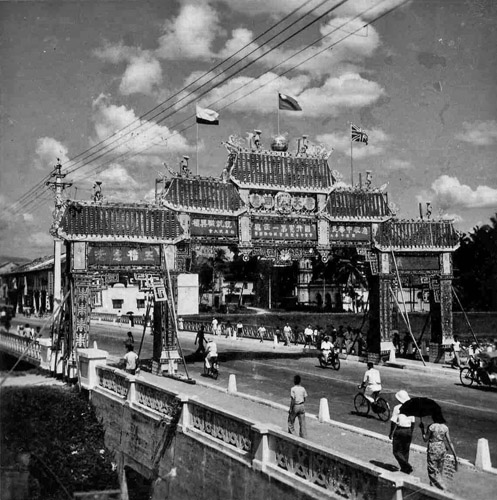
The Famous Arch, over the Hugh Low Bridge

This arch was set up over the Hugh Low Bridge, in Ipoh, somewhere in 1947. This was before the grand parade – which was held in support of the Kuomintang Party (led by General Chiang Kai Shek).

Notice the three flags at the top of the arch: the Perak Flag, the Kuomintang Flag and the Union Jack. To what we know, this parade was jointly sponsored by the Chinese Assembly Hall members and the Chinese Chamber of Commerce.

How many of you out there remember this arch? Anyone witnessed the parade, or maybe took part in this parade?

Related Posts with Thumbnails

7 comments to The Famous Arch, over the Hugh Low Bridge

  • Hi ipohworld,

    Thanks for this interesting photo. From this picture above, I can imagine how the bridge looked like in those days. Now, I can see it with my own eyes. My parents told me they used to walk along this stretch on their dates, circa 1948 when they were first introduced by a matchmaker, to their wedding in 1950.

    My mum used to stay in one of the squatter houses along the river bank with her family. She told me that when the Japs blasted the bridge, many people died and the river turned red with blood. At night, they could hear the wailings of those who have perished. It was so loud and clear, the squatters could hardly sleep. “They are coming. The Japs are coming” could be heard until the settlers there decided to get a Taoist priest to hold a ceremony to bless the dead souls. After that ritual, calm returned to the squatter area along the river bank and the people could sleep again.

  • LMS136

    Hi ipohgal ,

    Thanks for making the first posting with a very interesting story . Behind the magnificence of the structure , therein lies a story of human tragedy and sacrifices .

    Similarly , whilst the Great Wall of China postures magnificently today as one of the 7 wonders of the world , there had been a tremendous cost in terms of the hundreds of thousands who had perished in order that the Wall could come into being in all its grandeur .

    I was studying the photograph very intensely this afternoon . I am not sure as to why there was any compelling reason to offer support to the KMT whose “mandate” to rule China was on the wane and who really had very little influence over the livelihood of the overseas Chinese in Malaya to invoke such emotive support . It was before my time of course and the feeling I now express is admittedly made in hindsight for which I stand to be corrected .

    My first impression is that the efforts and spirit that went into the construction of the arch portrayed the resilience of the human spirit which refused to bow to the savagery inflicted by the
    Japanese . The arch reflected a rebound of mankind and a celebration of life , the very spirit which ensures the survival of the human race whereas many of all the other living species in the world had perished and became extinct earlier on .

    My next observation was that , as history tells us , it did not take long soon thereafter for the Malayan Chinese to embrace and uphold their loyalty for the Federation of Malaya . The right to stake this claim as loyal sons and daughters of Malaya was backed up by blood , sweat , toil and sacrifices . Whatever their origin and whatever the cultural roots , Malayan Chinese proudly obtained and preserved their citizenship papers . They viewed themselves as Malayan of Chinese origin , not Chinese subjects of China and certainly , not even overseas Chinese .

    Today , we Malaysians of Chinese origin see ourselves as being very distinct from the Chinese in China , Taiwan and Korea . We do not feel inferior to them . If anything , we stand proud for our ability to adapt to Malaya and then Malaysia , to be able to live in harmony with other fellow Malaysians , to accord them respect , and to contribute to the synergy which powerfully makes Malaysia a unique country with great potential and promises but sadly , at times , this might not be robustly progressed .

    Even in the ’60s , if another arch were to be constructed , would it have been so outlandishly China Chinese in design ? I doubt so .

    For all intent and purpose , the
    photo with the bridge and its arch as the centre pieces could have been taken in any fairly
    prosperous town in China . The KMT flag had the place of honour with the Union Jack and the
    Perak State flag sharing equal honours in keeping with the Confucian tradition of giving deference
    to other concerned authorities .

  • felicia

    Hi Ipohgal and LMS136. just to let you, and everyone else know: i think they’re building a permanent arch over the bridge; i noticed the pillars there a few weeks ago – but don’t know how far they’ve progressed….
    Am also wondering about the design this ‘new’ arch would have…..

  • ika

    Hi Felicia, I think that these are going to be just 4 concrete towers. I cannot understand why they are needed as AGAION the detract from the heritage conservation aspects that the State Government are supposed to be promoting. Penang suffered from their Botanical Gardens arches but the people won and had them removed. In Ipoh we have these towers and an ugly arch in Little India now (not to mention the toilet). Why do government love to add these extras to everything when they are not needed?

  • OV

    As you can see, the pedestrian walkway is so wide.

    I hope our new bridge( now under construction) also consider this as a need.

    However, the new bridge has been given a new look but not widen.

  • NCK

    To this older posting, I’d like to make a comment. Before independence, Malayan Chinese had a deep connection with mainland China. Many people joined the revolutionary alliance of Tong Meng Hui, the earlier identity of Kuomintang at the time of Qing Dynasty, and provided funding for Sun Yat Sen. Even some participants of the famous Yellow Flower Mount revolt, happened in 1911, came from Malaya. Of those came from Malaya, Perak residents made up the majority. After Qing Dynasty fell, the alliance was registered as a political party named Kuomintang to regularize its status in the new government. During WWII, Malayan Chinese also joined Kuomintang army to fight against Japanese. Of course, it all happened before independence.

  • Pasupathy

    I didnt know that there was an arch there before, interesting, I am following this blog closely

Leave a Reply


You can use these HTML tags

<a href="" title=""> <abbr title=""> <acronym title=""> <b> <blockquote cite=""> <cite> <code> <del datetime=""> <em> <i> <q cite=""> <strike> <strong>