Chatterbox

Events

May 2013
M T W T F S S
« Apr    
 12345
6789101112
13141516171819
20212223242526
2728293031  

Would you like to be an original author of this blog?

We are looking for a limited number of authors who would like to contribute articles on this site, about heritage topics in Perak. If you would like to be one of our authors, please email us at info@ipohworld.org and we can register you as an author. However, should we find unsuitable content being proposed, the author and content will be deleted without notice. We look forward to hearing from you.

Anyone for Konkey?

The Konkey Game played in Ipoh & Surrounds

By IpohBornKid

Introduction:  When the X generation was growing up, they did not have affluent parents who would buy them toys, hi-fi sets or computer games.  They relied on their ingenuity and played games that cost nothing.  These games were usually played in the open air about 3 pm onwards when the sun was not so hot and the breeze was blowing.  In the weekends, it was played in the morning until 11 am and later in the afternoon.

In those days, there were abundant flat sandy soil or grass covered areas in vacant building lots and the compounds of the village houses.  Children whose neighbours (aged between 6-12) were played together and they developed a strong bond among themselves.  They grew up together and as they matured into adolescence, another generation of young kids took their place.  It was healthy outdoor exercise and the parents were never worried about what their children were up to because they played with the children of their friends or neighbours. 

The Game:  The “Konkey” (name derived from English word “Donkey”) game is a team game similar to cricket.  Instead of bat and ball, it has two sticks,  diameter around 2.5 cm or less, and the long stick (LS) is about 50 cm in length with the short stick (SS) about one third of its length.  The LS is equivalent to the bat and the SS is equivalent to the ball.  In cricket, the ball is bowled by the bowler and the batsman defends his stumps with his bat.  Similarly, in the Konkey game, the opening player launches his SS with his LS from a trench in the ground and he defends his trench with his LS.

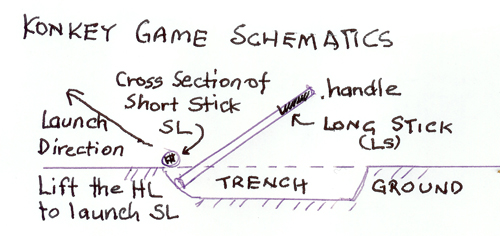
 Before the Konkey game starts, a trench is dug on the ground about 20 cm long, 5 cm wide tapering on the ends, and about 4 cm deep.  Two sticks as described above are used as bat (LS) and ball (SS).  The SS is placed on the ground across the trench and is launched by the LS.  The most effective way to launch is to place the LS in near the front of the trench and below the SS.  You can change the angle of launch by moving the LS left or right.  Usually most launches are perpendicular to the SS.  Pushing the LS into the ground, the launcher lifts his LS and propels the SS up in the air.   This is called launching the SS (ball).  Please refer to schematic diagram.

 The game begins after two teamsare selected and a toss to see which team launches (bat) first.    The launch team stay behind the trench and the field team spreads out in the field and strategically position themselves to catch the SS. 

 The first player in the launch team prepares himself to launch the SS with his LS,  The launcher lifts theSS in the air and generally puts it in a direction where there is no field player to catch it.  When the SS is caught by a field player, the launcher is out and the next launcher in the team takes his place.  The team is all out when they have exhausted the launcher (all bowled out) and the points are totalled.. (See point scoring next).  If the score is less than 100, the team change sides and the field team become the launchers.

\When the field players failed to catch the SS, it falls on the ground.  At this stage, a field player will pick up the SS and attempts to throw the SS back into the trench (trying to hit the stumps) with the launcher defending the trench (like a batsman) with his LS.  He can whack the SS stick whilst it is still in the air.  The field player can try to catch it.  If they did, the launcher is out.  If not, the distance between the position of the LS and the trench forms the basis of points scoring.  Using LS as a measuring rod, the launcher scores one point for each length of the LS measured.  The score is cumulative for the team.

If the first measure is not taken,the launcher can ask for second throw.  This is only safe when the SS is a considerable distance from the trench.  The rule for the second throw is the same as the first throw.  If on the second throw, the SS is caught, the launcher is out.  If SS is falls on the ground, the distance between the SS and the trench is the basis of point scoring but this time, the SS is used as a measure.  Hence, on the second throw, the point score tripled (since one LS is 3x the length of SS).

On reaching a 100 points, (arbitrarily agreed target points), the launcher team wins the game.  However if all the launchers are out and the score is below 100, the team changes sides and the game starts again.

 The penalty part of the game varies from village to village, town to town.  In one version, the winning team player holds the SS in one hand, drops the SS and whack it with the LS held by the other hand.  One of the player  in the losing team then picks up the SS in his hand and runs towards the trench.  As he is running, he has to say “Konkey, konkey, etc. all the way to the trench whilst the winner player gently whack his bum with the LS,  After the penalty, the game starts again,

Related Posts with Thumbnails

10 comments to Anyone for Konkey?

  • eric

    There’s another way to play this game of two sticks. Usually the sticks from cut from broom sticks. About a feet long.

    Usually we rest one stick on a small stone boulder with one end touches the ground, and the other hanging in the air. We hit this end which makes the stick “jumps” up where we will then hit with another equal length stick as hard as possible.
    Your competitors will try to catch it, or kick it. And then, using the caught stick, he will then measure the distance from the spot the stick was dropped to the spot where it was hit. This is done by rotation motion from end to end.
    The winner will be the one who had hit the furthest. Competitive game but also dangerous..

    btw…anyone still remember the popiah game..? where a tennis ball is hurled up into the air, and whoever caught it can use it to throw at other players. Its a pretty intense game. Some time temper could flare when one is hit even after he has said “choop” aka pause.

  • Jeremy@Palohchai

    I think I’ve played a similar game before, it’s called kunda-kundi, or in cantonese liu chai

  • hasbi

    Yes, konda kondi, my indian friends called it ‘kaunda kaundi’.
    I’ve played this similar game till 12 years old.

  • Joey

    yeap..cantonese is call “liu chai” …. now no children playing this kind of traditional game liou.. wasted !!

  • Wong Soi Yin

    Haha, this was a game that I liked very much in my primary school days. We played it slightly differently…. the launcher starts using the “SS across the trench” method. If it was not caught, the distance would be measured with the LS. Then he was given a second chance to launch, this time by the method eric mentioned,one end of SS in the trench, hit the other end with LS, whack it when it jumped up. If it was not caught by the opposition, the distance is measured by the SS. This was really a very exciting game. Although there was a chance of being hit by the stick on one’s head, caution was thrown to the wind. This used to be our favourite game cos both genders can join in.

  • AHLAI

    I remember playing this game in my village. The player in had to execute three procedures.
    The first procedure was to scoop the SS with the LS from the trench.
    The second was holding the SS and hit it with the LS.
    The third, which required more skill, was to incline the SS on the trench, hit the protruding end of the SS, and as the SS springs up from its resting place, hit it with the LS.

  • Kheesan

    This is a beautiful game – can be played everywhere. However, in those days there is no sense of danger as the sticks are quite hard. Nowadays, this will most probably be banned :( .

  • Charlie

    Used to play the short version of this game (ie one on one), while waiting for Mum to pick us up after school, in front of St Micheals. Those days, in the sixties, Clayton Road was only two lanes and there was quite a wide stretch of earthy ground between the School fence and the Road. Today, it is all Tarmac. However, once we entered Form one, and were officially allowed to use the main playing field in front of the School, it was football all the time. No more silly childrens’ games!!

  • PohYin

    What about “sooi kwai goh hor” (Cantonese)…. anyone remember that?

  • AP@IpohBornKid

    Dear PoiYin – In one version of the game played in the front veranda of a house with 4 pillars (of a rectangle), each player occupies a pillar with the 5th player without a pillar starting approximately in the middle of the rectangle. The 5th player announces “sooi kwai pok cheong hor” literal meaning, water devil connecting long river. After the announcement, the players facing diagonally to each other changes position and the 5th player then rush to the vacant pillar. The player without a pillar becomes the 5th player who makes the next announcement. “Sooi kwai pok dean hor”, literal meaning water devil connect short rivers. This announcement will cause the players facing each other on the short side of the pillars to exchange positions. The 5th player then proceeds to occupy an empty spot and the player without a pillar becomes the 5th player.

Leave a Reply


You can use these HTML tags

<a href="" title=""> <abbr title=""> <acronym title=""> <b> <blockquote cite=""> <cite> <code> <del datetime=""> <em> <i> <q cite=""> <strike> <strong>